CONFRONTING NIGERIA’S STRUCTURAL PATHOLOGY AHEAD OF 2027
Our Editorial Team
President Bola Ahmed Tinubu’s nationwide broadcast marking Nigeria’s 66th Independence Anniversary attempted to project a monumental shift from an “Age of Reform” to an “Age of Prosperity”. In his address titled “From Reform to Prosperity,” the President asserted that the country has finally navigated its harshest economic phase, comparing his policy decisions to an emergency surgery that excised structural cancers inherited from successive administrations.
From the perspective of the state, macroeconomic growth figures and a rebuilding of foreign reserves point toward a trajectory of national recovery. However, the institutional reality observed across the federation severely undermines this optimistic executive posturing.
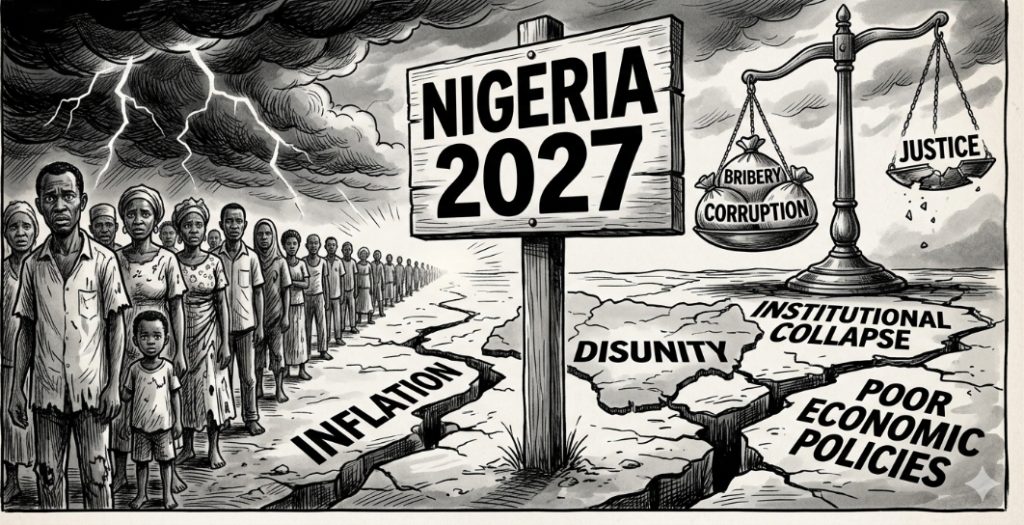
For the vast majority of citizens, sixty-six years of statehood are defined not by stabilization, but by a persistent and corrosive governance crisis, marked by poor economic policies, hyperinflation, institutional decay, judicial compromise, systemic disunity, and deep-seated electoral partiality.
As the nation steadily marches toward the 2027 general elections, treating these systemic vulnerabilities remains an absolute prerequisite to avoiding total socio-political destabilization.
The fundamental disconnect between official rhetoric and the lived reality of Nigerians lies primarily in the immediate consequence of the administration’s economic choices. While the President claimed that his administration’s painful measures corrected the nation’s course, the premature execution of subsidy removals and currency unification without adequate stabilizing buffers has instead yielded devastating outcomes.
These poorly implemented economic policies have triggered historic inflation, driving up the cost of food, transportation, and basic healthcare to levels that are entirely unsustainable for ordinary households. Instead of fostering productivity, these policies have crippled domestic manufacturing, eroded purchasing power, and exacerbated widespread poverty. When governance is reduced to implementing fiscal adjustments without an empathetic understanding of their human cost, it ceases to serve the public interest, transforming instead into an exercise in economic disenfranchisement.
This economic volatility is worsened by the pervasive collapse of public institutions and an unprecedented crisis of confidence within the third arm of government.
The civil service, law enforcement apparatuses, and regulatory bodies have largely been compromised by bureaucratic ineptitude and structural corruption, prioritizing political self-preservation over administrative integrity. Parallel to this administrative decline is the dangerous erosion of judicial independence.
The judiciary, traditionally viewed as the final arbiter of justice and the custodian of constitutional democracy, is increasingly seen as susceptible to political manipulation. A reliance on legal technicalities to settle highly contested electoral petitions has deeply alienated the populace, weakening the moral authority of the courts. When a society collectively loses faith in its legal institutions to deliver transparent and impartial justice, the very foundation of democratic order begins to fracture.
Furthermore, the domestic landscape is currently fractured by severe internal friction and regional alienation. Despite the President’s rhetorical appeals for cohesion, actual national unity remains elusive. Ethnocentric politicking, systemic marginalization, and economic despair have widened historic fault lines, intensifying separatist agitations and fostering a profound sense of disillusionment among the youth. This alienation has directly fueled an unprecedented brain drain, driving Nigeria’s highly skilled professional class out of the country in search of stability abroad.
Compounding this fragmentation is the critical issue of electoral partiality. The Independent National Electoral Commission (INEC) continues to battle a severe trust deficit following contested cycles. If the electoral umpire is widely perceived as an extension of the ruling elite rather than an impartial arbiter, the fundamental social contract between the government and the governed is effectively broken.
The political machinations ahead of the 2027 general elections demand that these structural failures be resolved immediately. In today’s broadcast, President Tinubu warned regressive voices against exploiting contemporary hardships for political mileage ahead of the next electoral cycle. Yet, the administration must realize that political stability cannot be sustained on compromised institutional foundations or an alienated electorate.
If the 2027 polls are approached with the same compromised machinery—a partisan electoral body, an un-cleansed judiciary, and unchecked state-sponsored partiality—the resulting civil friction could deal a fatal blow to the nation’s fragile stability. Sustainable democratic progress cannot survive in an environment where citizens believe their votes are inconsequential and where the economic environment pushes millions into extreme poverty.
To steer the republic away from the precipice, the federal government must urgently implement structural reforms that go beyond superficial fiscal numbers.
First, President Tinubu must demonstrate a genuine commitment to democratic integrity by ensuring total institutional and financial independence for INEC, decoupling the appointment of electoral commissioners entirely from partisan influence.
Second, the National Judicial Council must launch an aggressive self-cleansing exercise to restore the credibility of the bench, ensuring that post-election disputes are arbitrated with transparent impartiality.
Third, the administration must transition away from poorly managed economic adjustments by introducing robust, productive policies that systematically curb inflation, reduce the cost of living, and stimulate local industries.
Finally, true national cohesion requires a shift toward authentic fiscal federalism and inclusive governance that addresses the deep-seated grievances of marginalized regions.
At 66 years old, Nigeria can no longer afford to manage its structural decay with temporary fixes.
The path toward 2027 requires absolute transparency, administrative accountability, and an enduring commitment to the rule of law.